Headquarters building with in-house comms and IT room
During the early stages of the COVID-19 lockdown, this client decided to increase setpoints to save money when buildings were not occupied. This increased ambient temperatures and put operational pressure on areas of the building that needed to remain at lower temperatures, such as IT and Communications equipment.
The condensate pump developed a fault/blockage, which would have been impossible to detect until the water/humidity levels reached the point where a leak started without The Risk Observer. The cost of the repair was approximately an hour of time, and avoided a major loss with physical damage, business interruption and service downtime due to the early detection of the potential fault due to the Risk Observer.
Fire suppression
For this client the sprinkler system was losing pressure as the jockey pump was running 3-4 times per hour rather than per day. The service provider refused to believe that there was a leak caused by equipment/pipe failure from the pump house to the building. Sensor data captured by The Risk Observer provided the evidence, and the Insurer and insured were able to get a maintenance call out for a free-of-charge repair under warranty. This led to complete/total loss avoidance and no-cost repair to the client for the suppression equipment, thanks to The Risk Observer
Local Authority
In this example the changing rooms in a Leisure Centre, providing shower and changing facilities, had an issue. A fault in the hot water system caused the cold-water tank temperatures to rise to a level that could have caused a potential Legionella outbreak. The Risk Observer detected this, avoiding a potentially substantial risk to clients and liability issues.
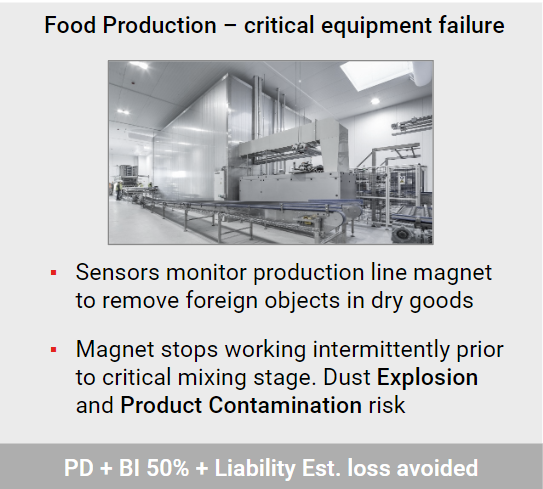
Food production
For food production, equipment should be running 6.5 days per week 24 hours per day. The Risk Observer was able to capture the data to show that the particulate metal detector was not running for approximately 2 hours per day for various reasons, which could have resulted in a dust explosion/contamination risk.